Return to Golden Axe II

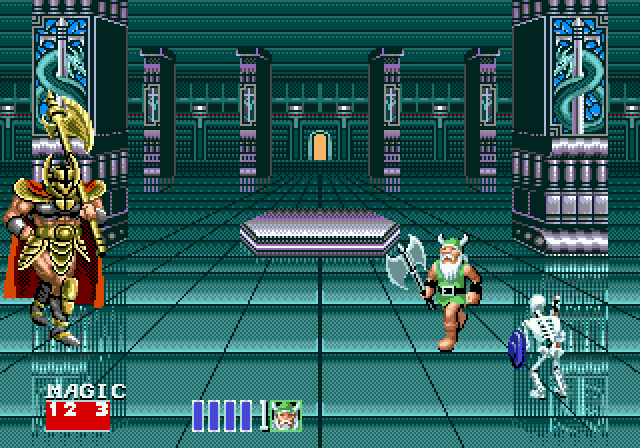
Golden Axe II has been one of my favorite games that I used to play back in the 90s with my Sega Mega Drive. I didn’t own a copy. I borrowed this game several times from a friend. I played it. I played it a lot. Today I have a Retro Trio that can be used to play NES, SNES and Mega Drive cartridges. So, some time ago I figured that I definitely should get a copy of this great game. Finally I made the purchase and it wasn’t even a pricey game. I bought it for 30 euros.

Golden Axe II was released 1992 as a PAL version in Europe. You just have to admire how well this game was made. It is an old game. I think there’s just the right mixture of fantasy and realness. There are dragons, axes and swords, magic and different kinds of monsters. Graphics were good when the game was originally released and they still feel pleasant considering it is a retro game. Playability seems nice. It is a beat-em-up game but you still find a rich environment that includes lots of fantasy elements. This game could have even some role playing game features but I think it wasn’t a time for that kind of a game to be released back in 1992. I think this combination of action, adventure and roleplaying was reached later when games like Diablo became very popular.

I have always been a bit doubtful on fantasy and roleplaying. I haven’t got in to this kind of material so much. I like FPS and racing games more. I just like to concentrate fully on the game and get rid of my everyday worries and stress. So, games involving deep fantasy elements aren’t so appealing to me. I also find fantasy books not so interesting. Maybe some day I pick up one of those Tolkiens books and start reading it. You may like roleplaying, stories and fantasy elements. It just isn’t for me.

One thing I haven’t really written about here in this post is that the first Golden Axe was a kind of a pioneer in artificial intelligence of enemies. It was among first games that used this kind of programmable variety of different kinds of actions. You can clearly see these elements when you are playing also the sequel. In the beginning of the game you have to make your choice about which player you wish to begin your journey with. You have a hero with a powerful axe but not so effective magical attacks and a hero with a sword and very powerful magical attacks. And I think the third hero is something in between of these abilities.

I finished the game in the roughest difficulty setting with the hero that had a sword and more powerful spells. I finished the game in maybe two hours but you have to take into consideration that I have played this game a lot. It is still one of my favorites when there is a conversation about Mega Drive’s best games. It’s a bit sad that there hasn’t been a modernized version of this game. I think it has a lot of potential. I can clearly see it to be improved a bit. It would be so cool if someone would include some elements of character development when for example experience points would be gathered. The levels could be larger. And if graphics and sound effects and music could be updated that would be almost surreal. I have to mention one more time that the world that Golden Axe brings is very interesting and pleasant in all of its details. In every way it would be amazing if a proper remake of this classic would some day be made.

History Of Optical Drive (inside gaming)

Optical drives have existed in gaming consoles for tens of years. The technology existed way before it was used in mainstream game devices. Back in the 90s there were several consoles that were equipped with optical disc drive. One of the earliest was the expansion to Segas Mega Drive called Mega-CD.

As Compact Disc technology gained ground there was a strong change coming in the form of 3D technology. Sega maybe was one the firsts to make use of new technology but it made a slight mistake. It didn’t have a gaming console capable to produce 3D models and/or graphics. Later Sony made its entry to gaming business with PlayStation and claimed its spot as the developer of the most popular gaming system.

During this period there were several devices released from Philips, Atari and Panasonic just to name a few. The competition was tough. We can compare the amount of data that game cartridges had to what was possible through CD technology. An average CD-R disc holds 700 MB. Nintendo 64s cartridges hold only about 35 MB. This meant that there was 20 times more space for any game to be developed.

First CD-ROM made its way and later came DVDs in the form of Sonys PlayStation 2. This was back in the beginning of 2000s. DVDs offer about 4,7 GB of space. This format was followed by Blurays that hold data from 25 GB up to 100 GB depending on which technology it uses or to say more precisely how many layers the disc has. Blurays are used in the latest generation of gaming consoles but this is about to change as PS5 and Xbox Series X are making their way to the markets later this year.

Todays games can take up so much space that you have to download a large update during the installation of the game. As speeds of internet connections keep developing it is today possible to produce gaming consoles and computers that don’t have, or don’t need to have, any optical drives. This gives the consumer an ability to just pay the game and install it directly to the hard drive. Of course this makes it easier to manage game collections but maybe something is lost as there is no physical material to collect or showcase. All in all digital gaming makes manufacturing gaming devices cheaper and it also shows this way to the consumer. PS5 will be released as all-digital version and a version that has an optical drive just to mention an example.

Creating the sound of Mega Drive

Music has always been a big part of video games. From the earliest soundtracks of Commodore 64 to the CD quality output of the first Sony PlayStation this genre of video game music has been developing as time has progressed. PS1s sound cannot be classified as chiptune. We are here going to concentrate to earlier sound worlds of consoles and especially to Sega Mega Drive. If you didn’t already know I am going to also mention that Mega Drive and Genesis are basically the same. The name Genesis was used in USA. But the consoles are the same.

Commodore 64 wasn’t as powerful as Mega Drive. It still plays a big role in the development of video game music. Many good principles of making music were first introduced to music producers when there were C-64 games soundtracks created. Back in 80s the music was generated with applications called trackers. It differs in many considerations from music production today. Today it is common for a musician to have a fairly powerful personal computer, software and a keyboard and a microphone. At some times producers used hardware synthesizers and even samplers (mainly hip hop). Today it is common to have virtual intruments that are called VST instruments or to put short VSTi’s. There is also effects which are called VST effects.

So how does modern music production relate to retro games music? It is interesting because many artists or hobbyists are still interested in the worlds of sounds that were created over 20 years ago. They still sound freash. Even if they have this sort of a retro feel. It is still interesting how they actually managed to get quality sound out of these primitive devices. This sound is actually a genre that is called simply “Chip Tune”.

I am going to tell you how you can basically build this sound and compose as original chip tune artist. You first need a VSTi host app. I prefer free one so you can download a program called LMMS (Linux Music Making Studio) that runs on both Windows and Linux. I prefer also Linux and VSTis don’t even work today on Linux. Then you will need a proper free VSTi. We are going to use a synth called Genny. You can see this posts featured image. That is the GUI of Genny. Don’t be afraid of the look of this image – it has many ready-made presets so you don’t necessarily have to make your owns.

In LMMS you load a thing called VeSTige. That’s the actual host for VSTis. Then, if you have already Genny’s .dll-file downloaded, you can load it up to VeSTige. It’s that simple. Feel free to change presets and play sounds from your MIDI- or even regular keyboard. Nice! If you have any difficulties just try to search with Google for additional tutorials and tips. I am not going to tell you everything about VSTis and LMMS, but I am very sure that you will find information about these if you proceed to create your own tunes with these tools. This was just a few words about generating some chip tune music. Bye, for now!